
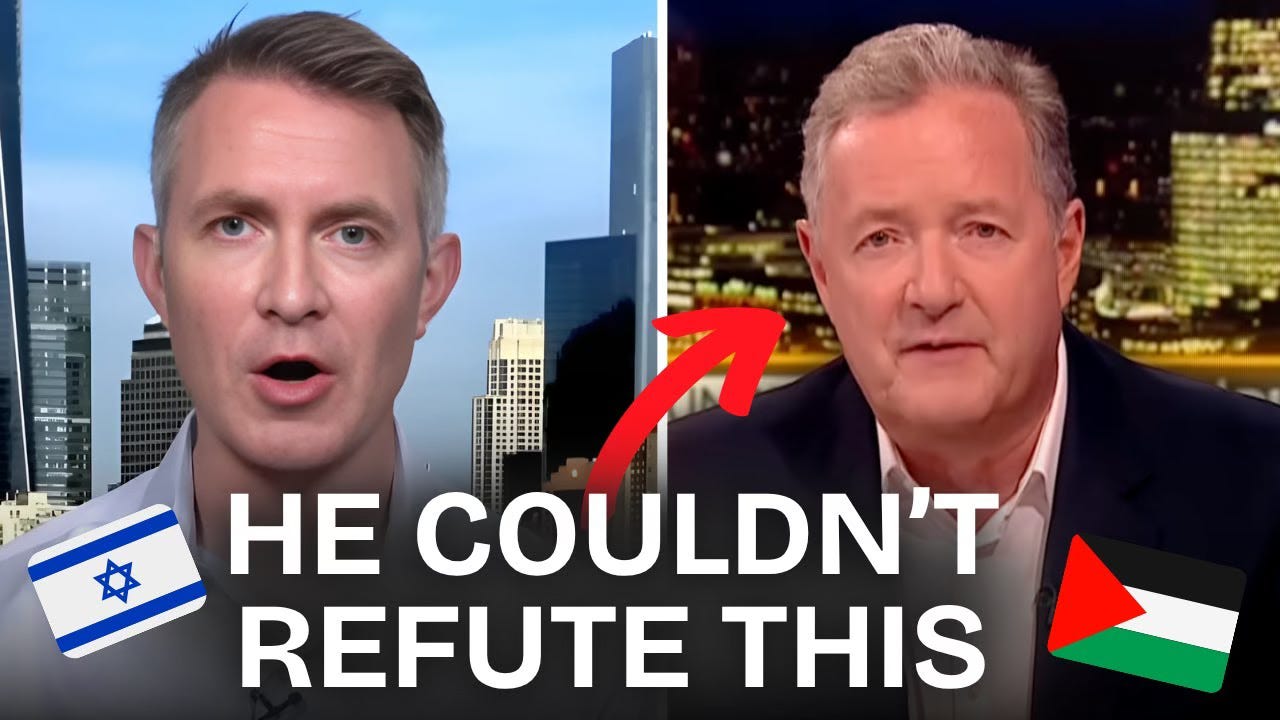
Piers Morgan frames the segment around a familiar assumption:
Israel must eventually compromise, and Netanyahu is the obstacle.
It’s a clean, digestible narrative — and one that many viewers already hold.
But it collapses immediately once Douglas Murray begins speaking.
Here’s the breakdown of why.
1. Piers Opens with a Premise, Not a Question
Piers doesn’t ask a neutral question.
He presents a conclusion wrapped as a prompt:
“Something has to give.”
“The only way forward is compromise.”
“Netanyahu is incapable of offering one.”
This is framing, not inquiry.
The audience is being guided to see Netanyahu as the bottleneck before any evidence is presented.
The issue is that this framing contains a hidden assumption that Murray immediately exposes:
That Hamas is a willing negotiating partner.
Once that assumption is questioned, Piers’ entire premise loses its foundation.
2. Murray’s First Move: Flip the Presupposition
Murray’s response doesn’t address the emotional weight of Piers’ question.
Instead, he performs a simple but devastating maneuver:
He identifies the suppressed variable.
Piers’ argument only works if:
Hamas is capable of compromise
Hamas wants compromise
Hamas is incentivized to negotiate
Murray’s counter is blunt:
“It is not Netanyahu who is uncompromising. It is Hamas.”
This inversion is the turning point.
It shifts the burden of proof.
Suddenly, Piers’ framing looks incomplete rather than persuasive.
3. Murray Then Brings in History — But Only the Parts That Matter
Critics often drown arguments in historical detail.
Murray does the opposite.
He introduces precisely one historical variable:
2005 — the Israeli withdrawal from Gaza.
From there, he draws a straight line:
Gaza was handed over
Billions in Western aid flowed in
Hamas built tunnels, not infrastructure
Leadership enriched itself
Civilians remained in poverty
This isn’t just narrative.
It’s causal structure:
Money → leadership incentives → outcomes → inability to negotiate.
Once the causal chain is laid out, Piers’ premise — “Why can’t Netanyahu compromise?” — is now misaligned with reality.
The question becomes:
What meaningful compromise is possible with a party that has no incentive to build, only to fight?
4. Murray Uses One of the Most Effective Debate Techniques: Collapse the Timelines
Piers frames the situation as urgent:
global pressure
hostages
protests
impatience
desire for “something” to change
Murray responds by collapsing timelines:
“They could have done all of this in 2005.”
This does two things instantly:
Removes the moral emergency framing
Replaces “right now” with “20 years of missed choices”
This is devastating for Piers’ narrative because urgency is the backbone of his argument.
Without urgency, his demand for compromise becomes untethered.
5. Piers Loses the Structural Advantage Because He Never Controls the Frame Again
After Murray’s inversion and causal timeline, Piers has two choices:
Challenge the 2005→2023 history
Challenge the claim that Hamas is uncompromising
He does neither.
So the debate shifts from:
“Why won’t Netanyahu compromise?”
to
“Why is compromise even the expectation here?”
This is the moment Piers loses the structural advantage.
He cannot return to his original framing without addressing the new logic — and he doesn’t.
6. Murray’s Final Move: Redefine the Nature of War Itself
Murray closes with the cleanest argument of the entire exchange:
“Historically, wars end when one side wins and one side loses.”
This is a worldview statement, not a tactical one.
It functions as a meta-argument:
If compromise isn’t structurally available
If incentives make peace impossible
If Hamas retains the ability to fight
Then the expectation of “meeting in the middle” is fantasy
And Piers’ opening frame collapses completely.