
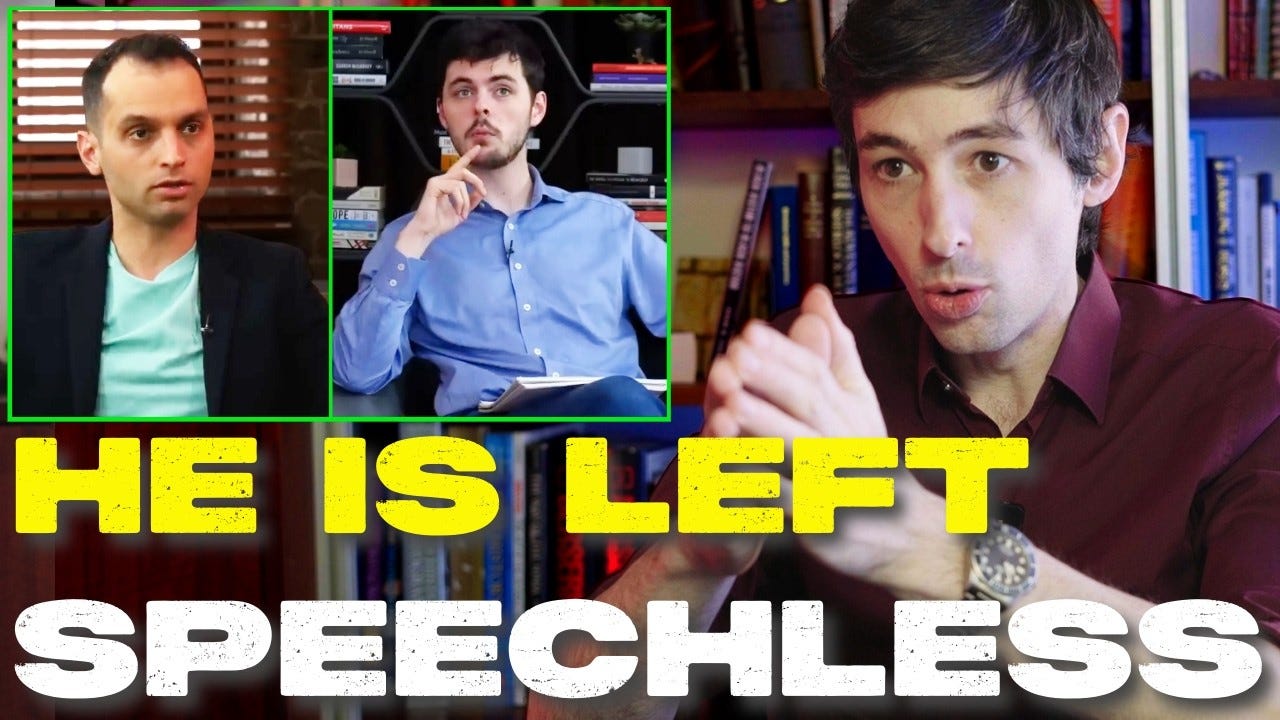
When Alex O’Connor sat down with Konstantin Kisin to debate hate speech laws, he came armed with what should have been a devastating move.
The logic was simple:
You already accept restrictions on speech — libel, defamation, copyright. You accept them because speech can cause real harm. So if harm is the standard, why draw the line before hate speech?
It’s a clean argument. It sounds reasonable. And for most opponents, it works — because most people can’t articulate why they accept one restriction and reject the other.
Konstantin could.
And that’s where the debate ended before it really began.
1. O’Connor’s opening move: put Kisin on a spectrum
O’Connor’s strategy was structural. He wasn’t arguing for hate speech laws directly. He was trying to collapse the distance between restrictions Kisin already accepts and the ones he doesn’t.
If you believe a newspaper shouldn’t be able to call you a pedophile with no evidence — and you’re willing to enforce that belief through law — then you’ve already conceded that speech can be restricted when it causes harm.
From there, it’s just a matter of degree.
This is a strong rhetorical move. It forces the opponent to explain a distinction most people feel instinctively but can’t define precisely.
The problem is that Kisin didn’t operate on instinct.
2. Kisin’s single bright line: adjudicability
Kisin refused the spectrum entirely. He didn’t argue that hate speech causes less harm than libel. He didn’t argue that one is serious and the other is trivial.
He changed the axis.
His position: the question isn’t whether speech causes harm. It’s whether a court can measure the harm.
With libel, a court can determine:
whether the statement was factually false,
whether it was published with intent or negligence,
and whether it produced damages that can be identified and measured.
With hate speech, a court cannot determine:
what “hate” means in the speaker’s heart,
where the threshold of harm begins,
or how to measure emotional damage caused by speech directed at a group rather than an individual.
This isn’t a difference of degree. It’s a difference of kind. One produces a workable legal standard. The other doesn’t.
And once Kisin planted that flag, O’Connor never dislodged it.
3. The anxiety argument exceeded its load-bearing capacity
O’Connor’s weakest moment came when he tried to establish that speech causing “lifelong anxiety” could justify legal intervention.
He acknowledged that this might seem like an overreaction. He conceded that the people affected might have a weaker psychological constitution. But he argued they didn’t choose to be that way — so the harm is still real, even if the vulnerability is unusual.
Kisin’s response was immediate and precise:
If someone on the internet gives you lifelong anxiety, the problem that needs solving is your anxiety — not the speech.
This landed because it exposed a structural flaw in the argument. O’Connor was trying to build a legal framework on a foundation of subjective response. The same words could devastate one person and roll off another. A court would have no way to determine whether the speech caused the harm or whether a pre-existing condition did.
Compare this to libel: if a national newspaper calls you a pedophile and you lose your job, your house, and your safety — the causal chain is traceable. The falsity is verifiable. The damages are measurable.
The anxiety example wasn’t on the same spectrum. It was a different category entirely. And by introducing it, O’Connor actually weakened his own position.
4. The copyright detour that backfired
O’Connor tried a second angle: intellectual property. He posed a hypothetical where someone copies Kisin’s writing and monetizes it. Small damages — maybe ten or twenty pounds. Kisin wouldn’t sue over it, but he’d want the legal right to exist.
The point was to show that even trivial, hard-to-quantify harms get legal protection — so why not emotional harm from hate speech?
But Kisin caught it immediately. Copyright infringement involves an objective act — a copy exists or it doesn’t. Monetary damages can be calculated, however small. The claim is verifiable by a court.
None of that applies to hate speech. There’s no objective artifact. There’s no measurable loss. There’s no falsifiable claim.
The analogy didn’t bridge the gap. It widened it.
5. Where O’Connor almost had something — and didn’t press it
There was one moment where O’Connor approached genuinely dangerous territory for Kisin’s framework.
He gestured toward cases where speech directed at a group could bring about serious physical consequences — not anxiety, not discomfort, but real-world violence or targeted harassment.
This is the strongest version of the hate speech argument, and it’s the one that serious legal scholars actually debate.
But O’Connor didn’t develop it. He let it dissolve back into the anxiety framing, which Kisin had already dismantled.
It also wouldn’t have saved his argument. Incitement to violence is already illegal under existing law. Targeted harassment already has legal remedies. You don’t need a separate hate speech category to address those cases — which means even the strongest version of the argument reinforces Kisin’s position rather than undermining it.
6. Kisin held one position and never moved
What made Kisin effective wasn’t rhetorical skill or emotional force. It was structural discipline.
He held a single claim: legal restrictions on speech require an objective standard a court can apply. Libel meets that test. Copyright meets that test. Hate speech does not.
Every time O’Connor tried to broaden the discussion — to emotions, to vulnerability, to hypothetical harms — Kisin returned to the same question:
Can a court measure it?
He never wavered, never reframed, never softened. And because the principle is genuinely coherent, O’Connor couldn’t crack it.
Conclusion
Alex O’Connor is sharp, fair-minded, and argued in good faith throughout. His opening move — putting Kisin on a spectrum of accepted speech restrictions — is the strongest version of the case for hate speech laws that exists in popular debate.
It failed because Kisin didn’t accept the spectrum.
The distinction was never about how much harm speech causes. It was about whether the harm can be objectively identified, measured, and adjudicated.
Libel can. Copyright can. Hate speech can’t.
That’s not a political opinion. It’s a structural reality about what legal systems are capable of doing.
And until someone finds a way around that line, the argument for hate speech laws will keep collapsing in exactly the same place.